Buying luxury property in Geneva: choose location and property type
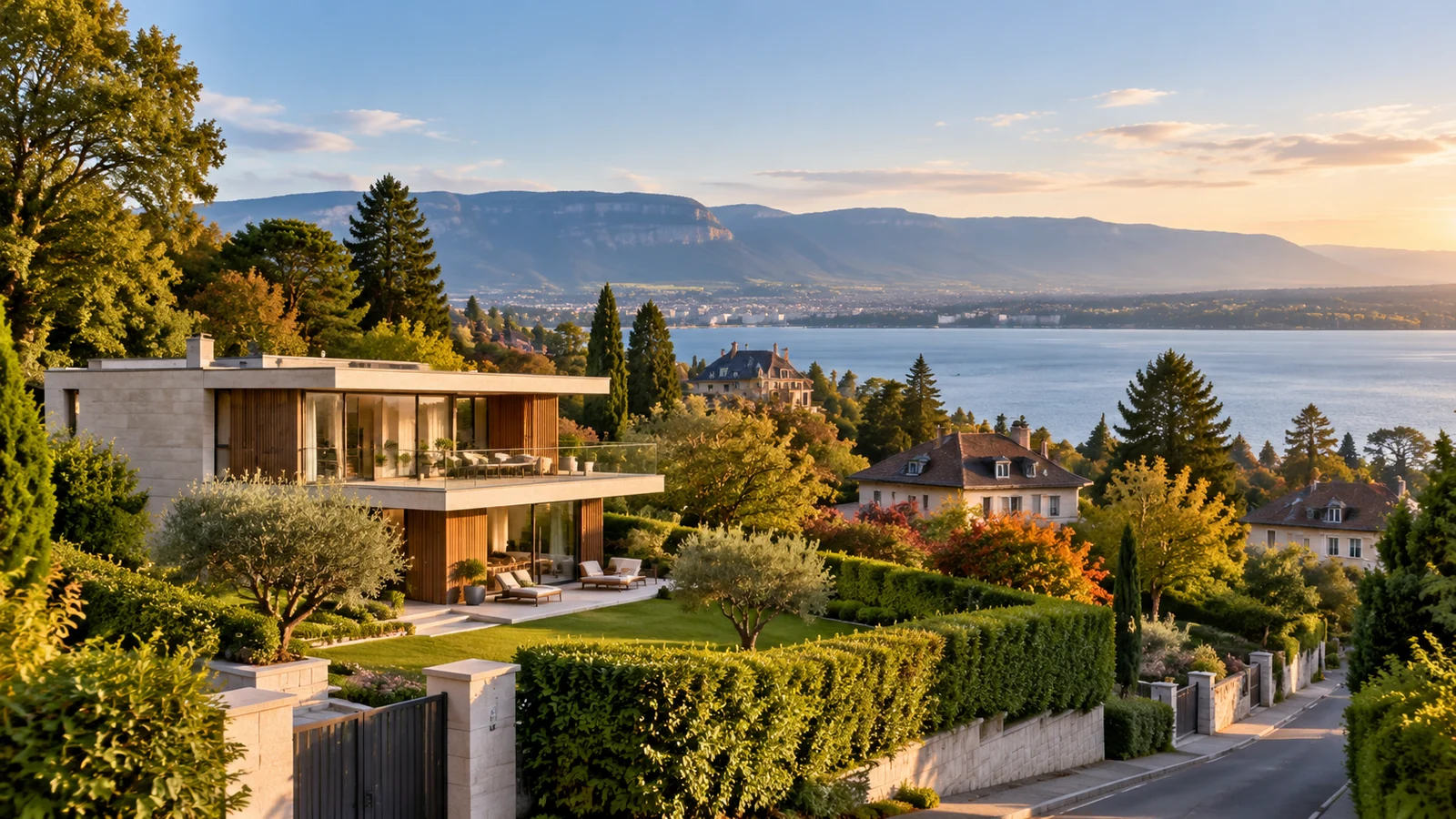
Buying luxury property in Geneva is first a choice of jurisdiction, intended use and property format—not a contest between glossy listings. A successful shortlist separates the City of Geneva from other communes in the canton, checks that the buyer may lawfully acquire the intended home, and compares asking prices against defined transaction evidence rather than promises of exclusivity.
In this guide
- Define the Geneva search perimeter
- Choose a property format for the actual use
- Build conditional submarket shortlists
- Test prices against the correct data
- Confirm acquisition eligibility before a deposit
- Estimate the full exposure in Swiss francs
- Screen individual properties without pretending to complete due diligence
- Issue a search brief and decide whether to proceed
- Sources / Official references
Define the Geneva search perimeter
“Geneva” may mean the City of Geneva, the wider Canton of Geneva or an informal cross-border lifestyle market. They are not interchangeable legal or statistical areas. Cologny, Collonge-Bellerive, Vandœuvres and Chêne-Bougeries are separate communes in the canton, not districts of the City of Geneva. A property over the French border is outside the Swiss acquisition, tax and land-register system discussed here. Require the exact commune, street and cadastral parcel before treating a recommendation as Geneva property; otherwise comparable distances, school logistics and ownership rules may be misleading.
Start with the residence plan, not a desired postcode: year-round family home, compact city base, staffed villa or investment holding produce different searches. State who will occupy the property, whether the buyer already lives lawfully in Switzerland, desired travel times at actual commuting hours, privacy and security needs, and the maximum cost including transaction expenses. Neither the word “luxury” nor a prestigious address establishes a property’s legal eligibility, condition or future resale value. Use these criteria to remove unsuitable formats before requesting introductions.
Choose a property format for the actual use
A city apartment can prioritise walkability, services and lower grounds maintenance, but shared-building decisions, noise and parking arrangements matter. A penthouse may add a terrace and views without exclusive rights over every roof surface; inspect the registered unit, plans and common-property rules. In either case, distinguish habitable interior area from terraces, annexes and parking. Swiss condominium ownership is commonly described as PPE (propriété par étages); check the PPE regulations, planned works and cost-sharing before assuming that advertising photographs define what is privately owned.
A detached villa offers more control over gardens, access and privacy, but increases responsibility for the building envelope, heating, drainage, tree maintenance and possible protected features. A large estate may also bring multiple parcels, agricultural or woodland areas and development constraints. Do not treat a garden, lake panorama, swimming pool or proposed extension as an unrestricted legal entitlement. Compare life-cycle costs, the privacy actually achievable on site and the buyer’s capacity to manage the asset—not simply gross floor space or land area.
Build conditional submarket shortlists
Use the following places as search hypotheses, not a verified price or prestige ranking. Within the City of Geneva, Champel or Eaux-Vives can be tested for an urban-apartment brief; outside the city commune, Cologny can be tested for villa-led or view-focused briefs, and Collonge-Bellerive, Vandœuvres or Chêne-Bougeries for different residential settings. Each commune contains variation at street and parcel level. A claimed lake view must be demonstrated from the actual habitable rooms and tested for possible future obstruction, rather than inferred from a commune name.
Ask two agents to apply the same boundary and specification before comparing offers. For each candidate, record commune, exact plot, property form, net useful interior area, separately described balconies and gardens, actual parking rights, renovation exposure, orientation and access time. A private road, nearby school, lakeside address or “off-market” label is a fact to verify, not automatic value. An apparent discount becomes irrelevant if it is an inaccessible use class, an incorrectly measured area or a property whose recurring obligations exceed the budget.
Scroll sideways to read the table ↔
| Area / actual municipality | Potential fit | Property-level test |
|---|---|---|
| City of Geneva: Champel / Eaux-Vives | Urban apartments, sometimes top-floor units | Test walking routes, street noise, access and PPE common costs; avoid assuming every address has parking or unobstructed views. |
| Cologny (separate commune) | Villa or apartment with view/privacy priorities | Verify specific orientation, access, parcel restrictions and view corridors; “Cologny” alone is not a price comparable. |
| Collonge-Bellerive / Vandœuvres | Garden-oriented houses and lower-density briefs | Compare commuting patterns, plot maintenance, services and actual building rights; no universal estate profile. |
| Chêne-Bougeries (separate commune) | Residential apartments or houses with transport priorities | Test street-by-street building type, noise and access; check whether a unit is ordinary PPE or regulated ZD PPE. |
Test prices against the correct data
Geneva’s cantonal statistics office, OCSTAT, publishes land-registry-based transaction statistics. Its 2024 key figures report 2,964 transactions, a canton-wide median individual-house price of CHF 2.190 million and a median of CHF 10,853 per square metre for non-new PPE apartments sold on the open market (CHF 10,284 for new apartments outside the development zone). These are broad historical benchmarks, not values for a Geneva luxury villa or an individual apartment. The denominators differ: house transaction value versus an apartment’s unit-area measure. Never apply the canton-wide median mechanically to Cologny, a penthouse or a listed estate.
For a fresher but less settled signal, OCSTAT’s second-quarter 2026 table (revised in the 22 October 2026 update) shows non-new house and apartment medians of CHF 2.285 million and CHF 1.415 million respectively; those are per-property figures, not a condominium square-metre price, and quarterly results are provisional. Ask an adviser for the reporting period, commune, number and type of closed transactions, new versus existing property, area definition and sample size. Listing prices are seller requests; a thin premium sample may not support a reliable median. Reconcile every exceptional property with defensible comparables and written assumptions. OCSTAT’s release of 22 October 2026 adds provisional third-quarter medians for existing properties: CHF 1.483 million per PPE apartment and CHF 2.395 million per individual house. These figures are per property, not per square metre, and do not establish the price of any particular luxury home. Do not turn shifts between quarterly medians with different sales mixes into an appreciation forecast.
Confirm acquisition eligibility before a deposit
Switzerland’s Lex Koller framework (LFAIE/ANRA) restricts acquisitions by certain persons abroad, including foreign-controlled entities. For EU/EFTA nationals, lawful and actual residence in Switzerland is crucial; for non-EU/EFTA buyers, permit and main-home facts can materially change the analysis. The federal authorities explain that a foreign national lawfully and actually resident in Switzerland can generally acquire a home at that principal residence without authorisation, subject to the specific rules. A holiday home, investment apartment, corporate vehicle or buyer living abroad cannot safely be treated as equivalent. Purchasing does not itself confer Swiss residence rights. The federal guidance distinguishes EU/EFTA nationals lawfully and actually domiciled in Switzerland and non-EU/EFTA nationals holding a valid C settlement permit, generally outside the ‘person abroad’ category, from non-EU/EFTA B-permit holders, who ordinarily remain within that category even if a qualifying principal home may be exempt from authorisation. A permit or commune registration alone does not prove actual domicile. The federal FAQ specifically states that a holder of Swiss protection status S needs authorisation even to acquire a main home; do not treat status S as an ordinary qualifying B permit.
Geneva’s Department of Institutions and Digital Affairs (DIN) is the cantonal first-instance authority. If the authorisation regime cannot be excluded, obtain the required decision or a formal finding of non-applicability rather than relying on a broker’s assurance. The canton describes distinct possible, conditional and prohibited acquisitions; land size, actual occupation and status may matter. Large plots and mixed-use or controlled housing require special attention. Make any offer and preliminary commitment conditional on a written eligibility and transaction-path assessment from the notary or appropriately qualified Swiss adviser. For buyers subject to Lex Koller, Geneva lists holiday homes and ordinary second homes as acquisitions that cannot be authorised; it separately recognises a limited second-home exception for qualifying EU/EFTA cross-border workers with a valid G permit. This is not a universal ban on all second homes held by otherwise unrestricted buyers. The canton also identifies principal residences on parcels above 3,000 m² as requiring a case-specific decision. Screen the buyer and the parcel together before considering an advertised lakeside estate.
Estimate the full exposure in Swiss francs
Geneva’s notarial chamber describes purchase-deed expenses in many ordinary cases as around 4% of the price: roughly 3% registration duties, 0.3% land-register fees and approximately 0.7% notarial remuneration and disbursements, with degressive scales and exceptions. That is an illustration, not a binding quote for a large luxury transaction. Mortgage-note creation can entail separate charges, and reductions linked to qualifying primary homes are subject to conditions and indexed thresholds. Request a transaction-specific written notarial estimate, including VAT treatment and any special authorisation work, before defining the cash required at completion.
Keep purchase price, one-off transfer costs, financing costs and yearly ownership costs separate. Stress-test property tax exposure where relevant, wealth/income tax circumstances, PPE service charges or villa upkeep, major works, insurance and potential vacancy. If funds begin in EUR, USD or another currency, model the CHF equivalent using a dated exchange-rate reference and the actual bank spread, conversion charges and transfer fees; no universal rate is assumed here. Obtain a lender’s indicative CHF financing terms and evidence of funds before entering a binding commitment. Potential resale proceeds or rental yields should not be presented as guaranteed.
Screen individual properties without pretending to complete due diligence
At shortlist stage request a current land-register extract identifying title, ownership form, rights and burdens; a cadastral plan; the applicable zoning and public-law restrictions; floor plans and a reliable area statement; energy/condition material; and, for PPE, its regulations, budgets, reserves and recent owners’ decisions. Geneva’s land register records real-property rights; the public RDPPF/SITG portal can display certain land-use restrictions, but a map does not replace certified records or expert interpretation. For a villa ask specifically about access rights, easements, permits for additions and potential heritage, water or noise constraints.
For apartments check whether the object is regulated development-zone PPE (ZD PPE), rather than assuming every condominium has the same use rights. Geneva explains that regulated units may face a ten-year state price-control period and, for units governed by rules in force since November 2016, an actual owner-occupancy requirement; exceptions require a competent decision. This may rule out a planned investment letting or alter resale timing. Ask the seller/notary for the original zoning and approvals, acquisition date, remaining control period and any authorised derogation before shortlisting the unit for rent or rapid resale.
Issue a search brief and decide whether to proceed
A useful search instruction is specific: “Principal family home, buyer status to be assessed, Canton of Geneva only, city apartment or accessible villa, CHF maximum including estimated transfer costs, minimum genuinely habitable area, documented parking, maximum door-to-door commute, acceptable renovation budget and no reliance on unapproved rental use.” Include two or three permitted communes and explicit exclusions, rather than asking every intermediary for “the best luxury property”. Require each introduction to disclose agency role, seller-side conflicts, available documentation, asking price and the date of every factual statement.
Use a three-way gate. Proceed to an independent notarial and technical review only if buyer eligibility, address, property format, evidence-based price range and total funding are coherent. Renegotiate or demand documents if the price rests on unverifiable views, incomplete PPE accounts, unresolved land restrictions or uncertain extra costs. Stop before a reservation, deposit or purchase promise where acquisition permission is doubtful, the intended occupancy is incompatible with applicable controls or the finance cannot withstand currency and maintenance risks. This is a market-selection framework—not a completed title investigation, investment forecast or legal opinion for a particular buyer.
Sources / Official references
- Swiss Federal Office of Justice — Acquisition of property by foreign non-residents
- Swiss Federal Office of Justice — Questions and answers on Lex Koller
- Republic and Canton of Geneva — Acquisition de biens immobiliers par des personnes à l’étranger
- Republic and Canton of Geneva — Procédure d’acquisition
- Republic and Canton of Geneva — Acquisitions possibles
- OCSTAT Geneva — Transactions et prix de l’immobilier
- OCSTAT Geneva — Transactions immobilières, deuxième trimestre 2026
- Chambre des notaires de Genève — L’appellation frais de notaire est trompeuse
- Republic and Canton of Geneva — Logements en PPE en zone de développement
- Republic and Canton of Geneva — Acquérir ou vendre un logement PPE en zone de développement
- Republic and Canton of Geneva — Consulter le géoportail du cadastre RDPPF
- Republic and Canton of Geneva — Consulter le registre foncier
- OCSTAT Geneva — Méthodologie des transactions immobilières
- Republic and Canton of Geneva — Communiqué du 30 septembre 2026
- OCSTAT Genève — Transactions immobilières, troisième trimestre 2026 (22 octobre 2026)
- Canton de Genève — Acquisitions impossibles (LFAIE)