Buying villas and houses in Vancouver
A premium house is only a viable purchase if the buyer can lawfully acquire it and the registered land, access, permitted use, building condition and total cost support the plan. This guide is a property-by-property screening framework, not a list of available homes. Reviewed 29 October 2026.
In this guide
- Define the house you can actually use
- Check legal buyer eligibility before an offer
- Tie the listing to the legal parcel and access
- Test lawful use and physical condition separately
- Compare modern features by performance, not appearance
- An initial screening matrix
- Test the site, envelope and running obligations
- Budget acquisition taxes and annual exposure
- Protect the transaction before conditions are removed
- Turn the shortlist into a go / revise / stop decision
- Official sources and guidance
Define the house you can actually use
Begin with two addresses: the property’s civic address and its legal parcel identifier (PID). “Vancouver” in a listing can refer to the City of Vancouver or a neighbouring municipality such as West Vancouver or the District of North Vancouver. These are not interchangeable for permits, zoning or the City’s Empty Homes Tax. Confirm the actual municipality before treating a view, neighbourhood label or promotional floor area as an actionable purchase specification. [S07][S11]
Write a shortlist specification before booking specialist reports: intended principal residence, occasional personal use or rental; minimum functional bedrooms; accessibility; parking and legal vehicle access; outdoor space; privacy; required travel times; renovation tolerance and an all-in budget in Canadian dollars (CAD). A waterfront outlook, steep hillside, mature landscaped lot and central detached house impose different maintenance and physical risks. Match each candidate to these requirements, not to a “villa” label, which is not a separate land-title category.
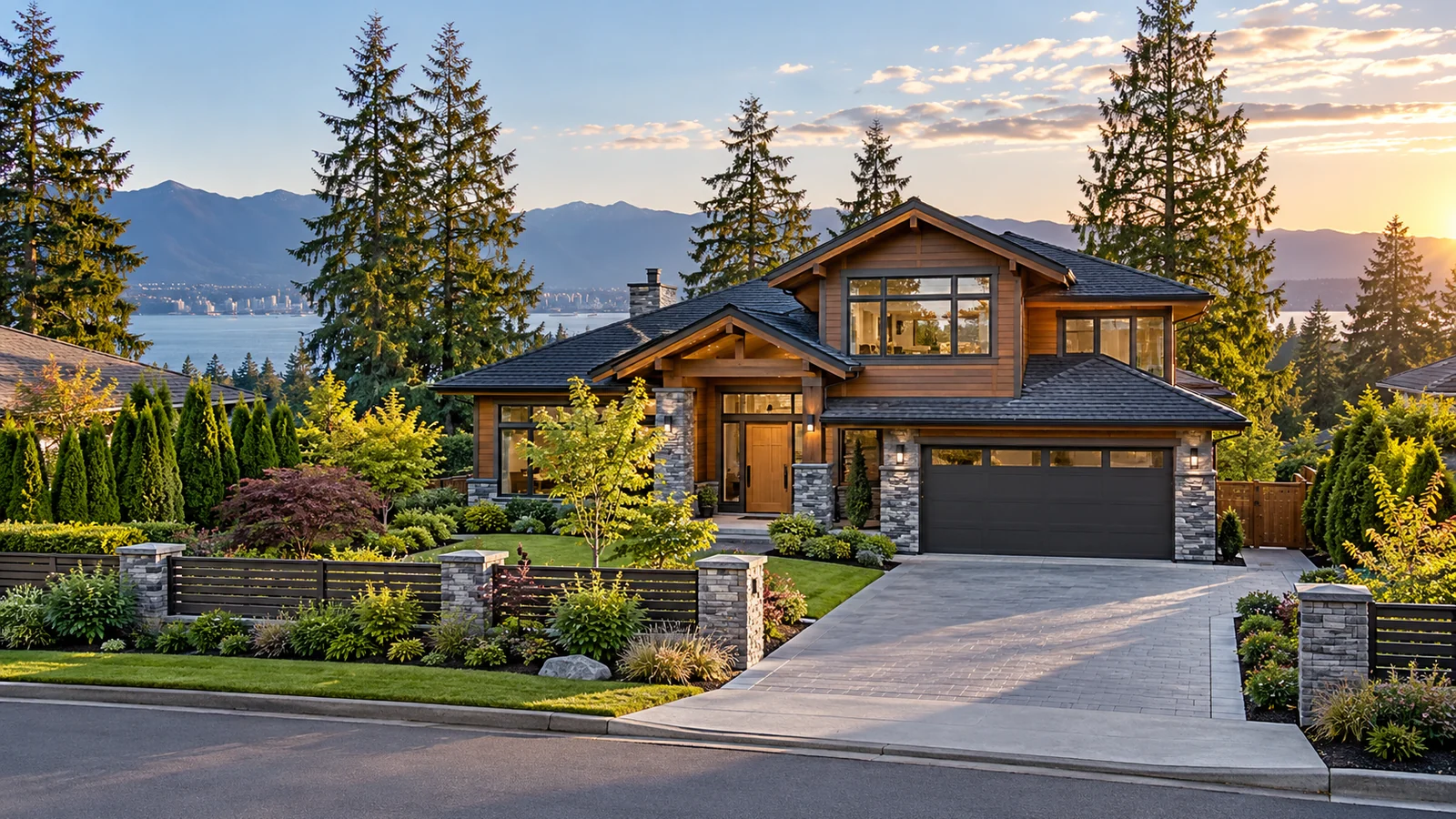
Contrast four purchase profiles. A mature urban lot can offer established services but needs scrutiny of alterations, trees and adjoining buildings. A hillside home adds drainage, retaining walls and slope access. A waterfront-facing house calls for closer water exposure, erosion and insurance questions; a view is not automatically private shoreline access. A larger estate may add gates, private lanes and intensive landscaping. These are screening prompts, not statements that a specific address has a defect.
Check legal buyer eligibility before an offer
At the 29 October 2026 review date, Canada’s federal prohibition on purchases of qualifying residential property by non-Canadians is scheduled to run through 1 January 2027. It generally covers direct or indirect acquisitions of buildings with up to three dwelling units in census metropolitan or agglomeration areas, including qualifying Vancouver homes. Nationality, Canadian permanent-resident status, the precise purchaser and property classification matter. A high purchase price, a Canadian corporation or a plan to rent the house does not automatically remove the prohibition. [S01][S02]
The federal regime contains defined exceptions, including certain temporary residents meeting prescribed criteria, protected persons, qualifying purchases with a spouse or common-law partner, and specified development acquisitions. Vacant land has been excluded from this prohibition since 27 March 2023; this does not turn an existing house into vacant land or exempt it from provincial taxes. Have Canadian counsel determine applicability to the named buyer and parcel before signing; an exception must be evidenced, not assumed from citizenship of a family member or a future immigration plan. [S01]
Federal purchase eligibility and British Columbia’s additional property transfer tax answer different questions. An individual might be entitled to purchase under a federal exception yet still need a separate provincial foreign-buyer tax assessment. Conversely, paying a tax never legalizes an otherwise prohibited acquisition. Confirm beneficial ownership and any corporate or trustee structure with a lawyer; residency for one law or tax does not automatically establish status for another. [S01][S05]
Tie the listing to the legal parcel and access
Obtain a current title search from the Land Title and Survey Authority of British Columbia (LTSA), together with relevant filed plans and instruments. The title identifies registered ownership; review charges such as mortgages, easements, rights of way, covenants and other restrictions with the closing lawyer. A marketing brochure, municipal street address or BC Assessment entry is not a substitute for title and a survey. Verify whether garages, terraces, secondary buildings and gardens sit on the same parcel or on separately held land. [S06]
Do not infer legal vehicle, pedestrian or waterfront access from a visible driveway, private gate or path. Check registered access rights, lane ownership, shared-driveway maintenance instruments and any utility rights that burden the land. Where fences, hedges or built features appear close to a boundary, ask a British Columbia land surveyor whether a current survey or site certificate is warranted. A boundary discrepancy may be curable; a vital access right that cannot be demonstrated is a reason to stop or make completion conditional. [S06]
Determine what is actually being acquired: a conventional fee-simple parcel, a strata lot in a detached-looking development, leasehold interest or another tenure. A standalone appearance does not prove fee simple or unrestricted use. Where strata or lease terms apply, request the governing documents, budgets, assessments, restrictions and remaining lease term, rather than using freehold assumptions. The suitability test is whether the legal rights support the intended occupancy, alterations, access and eventual resale. [S06]
Test lawful use and physical condition separately
For an address within the City of Vancouver, check its zoning district, permitted or conditional uses and existing permit record. The City offers property research and copies of certain issued permits and has a process for approved-use letters; some records require owner authority. Request plans and approval evidence for additions, suites, garages, decks and major alterations. Existing physical space does not prove lawful approval, and permission for a future renovation is never guaranteed. Other municipalities have their own record systems. [S07][S08][S14]
Arrange an appropriately scoped professional building inspection and then targeted engineering or specialist review where risk indicators appear: roof and building envelope, moisture, structure, foundations, seismic details, retaining walls, drainage and possible buried oil tanks or asbestos. Ask what was not inspected and whether concealed conditions remain. A fresh cosmetic renovation or seller disclosure is useful context but not a substitute for independent inspection. For major alterations, compare inspected work with drawings and permits. [S10]
Request real operating evidence: recent utility bills, heating and ventilation service records, drainage or sewer maintenance, tree-care plans, insurance quote and claims history where obtainable, and records for pools, elevators, security systems or private roads if present. Check who pays to repair shared access or infrastructure and whether appropriate coverage is available on acceptable terms before removing insurance or financing conditions. Neither a luxury listing price nor a generic cost-per-square-foot estimate establishes annual ownership cost.
Compare modern features by performance, not appearance
Examine architectural drawings against the building on site. Ask when the house and significant additions were completed, who designed major alterations and whether records exist. Distinguish a contemporary purpose-built home from an older house with a modernized facade. Neither is automatically preferable: the first may have complex proprietary systems; the second may conceal interfaces between old and new construction. Aesthetics are a reason to inspect, not proof of durability.
Large glazing and open-plan rooms may improve views and daylight, but warrant questions about overheating, heat loss, privacy, condensation, shading and sound transmission. Ask for window specifications, relevant energy documentation and a demonstration of ventilation, heating and cooling under normal operation. No single performance number can be inferred from a photograph.
Flat or low-slope roofs, roof terraces and dramatic cantilevers deserve a focused assessment of waterproofing, flashing, drainage, membrane age, penetrations and access for maintenance. Ask for repair records and an inspector or specialist familiar with the specific system. A visually clean roof edge can make defects harder to see; an attractive finish is not a warranty.
Sloping sites, retaining walls, extensive glazing below grade and sunken courtyards call for inspection of drainage, foundation waterproofing, structural movement, landscaping and water management. Obtain independent engineering input when observable conditions or missing records justify it. A beautiful garden or newly finished basement is no substitute for checking moisture history.
An initial screening matrix
Compare a candidate home in the following order: basic fit, evidence, exposure and ability to correct a problem. This table is a practical filter, not an assessment of any currently available property.
Scroll sideways to read the table ↔
| Feature | Potential benefit | Question or exposure | Evidence to request |
|---|---|---|---|
| Extensive glazing | Daylight and views | Heat, glare, privacy, seals | Glazing schedule, shading and mechanical records |
| Low-slope roof or roof deck | Clean silhouette and outdoor space | Waterproofing, falls, drains, access | Permit and inspection history, roof age, maintenance logs |
| Refitted older shell | Contemporary appearance in an established setting | Unseen old/new junctions or unauthorized work | Original and alteration drawings, permits, condition report |
| Hillside lot and retaining walls | Privacy, landscaping and potential outlook | Movement, drainage, access and upkeep | Survey, engineering evidence, drainage and insurance review |
Test the site, envelope and running obligations
Commission an inspection with special attention to roof, cladding transitions, glazing seals, mechanical systems, moisture intrusion, drainage and any accessible crawlspace. In exposed locations, examine trees, slope and retaining structures. The City publishes floodplain mapping for parts of Vancouver, including False Creek and Fraser River areas; a map is a screening signal, not an address-specific engineering or insurance assessment. Obtain specialist checks where the evidence warrants them.
Prepare an ownership budget beyond the mortgage: municipal property tax, insurance, utilities, energy use, landscaping, specialist facade and roof maintenance, security systems and reserves for replacements. Verify actual past bills, service contracts, warranties, transferability and insurance quotations for the property. Do not assume operating cost from floor area or luxury positioning alone. If the lender or insurer excludes an unusual system, that may change the purchase decision.
Budget acquisition taxes and annual exposure
British Columbia’s general property transfer tax normally uses fair market value tiers: 1% on the first CAD 200,000; 2% on the portion above CAD 200,000 up to CAD 2 million; and 3% on the portion above CAD 2 million. A further 2% applies to the residential portion above CAD 3 million. Exemptions and mixed-use classifications require a separate assessment. This is transfer tax, not the purchase deposit, legal fee, mortgage expense, annual property tax or potential GST on a taxable supply. [S03]
Illustration, not a Vancouver market quotation: on an entirely residential CAD 3.4 million taxable transfer, the general and further property transfer taxes total CAD 88,000 (CAD 2,000 + 36,000 + 42,000 + 8,000), before any applicable foreign-buyer tax, exemptions or other transaction costs. Obtain an address-specific closing estimate; property value, transaction structure, tax treatment and timing can change the actual amount. [S04]
An additional 20% British Columbia property transfer tax can apply to the taxable residential share acquired by a foreign national, foreign corporation or taxable trustee in specified areas including Metro Vancouver, subject to exemptions and the actual ownership interest. On the hypothetical CAD 3.4 million wholly taxable foreign acquisition, this could add CAD 680,000, taking those transfer taxes to CAD 768,000. That illustration does not imply such a buyer can lawfully buy under the federal prohibition. [S04][S05]
Vacancy exposure is separate. Within the City of Vancouver, the municipal Empty Homes Tax is 3% of the applicable assessed value for taxable vacant properties, with declaration and exemption rules. British Columbia’s speculation and vacancy tax in covered areas has 2026 rates of 3% for foreign owners and untaxed worldwide earners and 1% for other specified owners, subject to its exemptions and credits. The federal Underused Housing Tax no longer requires returns or payment for 2025 onward, although earlier years may remain relevant. Do not add all rates indiscriminately; test each tax and exemption independently. [S11][S12][S13]
Before completion of a City of Vancouver purchase, request the municipal tax certificate and seller’s filed Empty Homes Tax status declaration, together with available evidence of occupancy or exemption for the relevant year. The City warns that declarations can be audited and unpaid tax can affect the property account. Ask conveyancing counsel to consider seller representations, a statutory declaration and a contractual holdback or closing adjustment if liability is unresolved. A qualifying transfer may produce a reference-year exemption, but do not assume earlier liabilities vanish. This safeguard concerns the City tax; investigate the provincial vacancy tax separately. [S11]
Protect the transaction before conditions are removed
BCFSA guidance identifies negotiable “subject” clauses for satisfactory inspection, financing and document review. Have the offer specify whose satisfaction, evidence, access, deadlines and consequence of an unmet condition are required, plus an appropriate title, insurance, survey, permit and eligibility review. A seller need not accept an inspection condition, and a subject-free offer shifts significant risk to the buyer. Do not waive a condition because of an attractive showing or unsupported assurance; secure advice on the precise contract wording. [S09][S10]
For eligible British Columbia residential purchases, including an ordinary detached house, the non-waivable Home Buyer Rescission Period lasts three business days after the offer is accepted, not after subject conditions are removed. Rescission requires timely written notice to the seller and payment of 0.25% of the agreed price (CAD 8,500 on a CAD 3.4 million purchase). Exclusions include homes on leased land, leaseholds, auctions and court-supervised sales; certain development presales have separate rescission rules. Inspection and financing subjects can run concurrently; this right is not a substitute for them. If a buyer instead relies on an unmet contract condition, release of a brokerage-held deposit may still require both parties’ signatures. Verify dates, notice delivery and deposit custody with the conveyancer. [S15][S16]
Keep the steps distinct: shortlist and view, obtain records, inspect and price remediation, negotiate signed contractual conditions, satisfy or decline them, then arrange lawyer/notary conveyancing, funds and registration. Ask the lender about valuation, insurance, required down payment and funding timeline, and confirm currency conversion and bank transfer charges if the buyer’s funds are not CAD. Physical viewing or a video call does not establish that a signing, identity verification, mortgage or closing can be completed entirely remotely. [S09]
Turn the shortlist into a go / revise / stop decision
For each candidate, make one evidence matrix: civic address and municipality; PID and title; tenure and registered access; surveyed versus advertised boundaries and area; permitted uses and changes; building and specialist findings; operating/insurance records; purchase eligibility; transfer taxes; and unresolved contractual conditions. Name the owner of each document request and a deadline. Where the evidence is incomplete, classify the issue as “verify”, not as proof of safety.
Proceed to paid acquisition work when the intended use fits the verified rights, inspection risks can be priced and the buyer can legally transact and finance. Renegotiate price, remediation or a contract condition where a defect is measurable and curable. Stop when buyer eligibility cannot be established, essential access or title cannot be confirmed, intended use is not authorized, or a material physical/insurance risk remains unacceptable. Those thresholds should be chosen before emotional commitment to the house, not after a deposit has become difficult to recover.
Official sources and guidance
- Canada Mortgage and Housing Corporation — Federal foreign-purchase prohibition: scope and exceptions (S01)
- Department of Finance Canada — Two-year extension of purchase prohibition (S02)
- Province of British Columbia — Property transfer tax (S03)
- Province of British Columbia — Property transfer tax calculation examples (S04)
- Province of British Columbia — Additional tax: specified municipalities (S05)
- Land Title and Survey Authority of British Columbia — Search Land Title Records (S06)
- City of Vancouver — Property research and copies of permits (S07)
- City of Vancouver — Zoning and Development By-law (S08)
- British Columbia Financial Services Authority — Offers to Sellers (S09)
- British Columbia Financial Services Authority — Consumer Guide to Property Inspections (S10)
- City of Vancouver — Empty Homes Tax FAQ (S11)
- Province of British Columbia — Speculation and vacancy tax rates (S12)
- Canada Revenue Agency — Underused Housing Tax (S13)
- City of Vancouver — Apply for and manage a permit (S14)
- British Columbia Financial Services Authority — Home Buyer Rescission Period Consumer Guide (S15)
- British Columbia Financial Services Authority — Deposits (S16)