Buying a penthouse in Toronto: terrace rights, roof risks and real costs
In this guide
Which Toronto penthouse is worth shortlisting?
A penthouse premium is defensible only when the features you will use, the legal rights you will acquire and the building’s capacity to maintain them justify the difference from realistic alternatives. Start with your non-negotiables: indoor usable area, outdoor area that can actually be occupied, accessibility, number of lifts, privacy, layout, orientation, year-round weather exposure and a sustainable ownership budget. “Penthouse” is marketing language rather than a uniform legal class. A top-floor suite with no terrace, a two-level unit with a private rooftop and a similar high-floor unit can be very different purchases. Treat listing language as a question to verify, not proof of ownership or performance.
Shortlist at least a suitable penthouse, a comparable high-floor unit and, where relevant, a smaller building’s top-floor unit. Match closed transactions by building or micro-location, date, interior floor area, condition, parking, outdoor rights, ceiling height and fees; an active asking price is not a completed sale. Separate enjoyment value from resale assumptions: terraces may be unusable in certain seasons, while views, privacy and roof equipment may change. Reject an option early if the lift arrangement, minimum room size, outdoor access or projected costs already conflict with how you intend to live; no amount of staging cures a mismatch.
The terrace is a legal right, not just a photograph
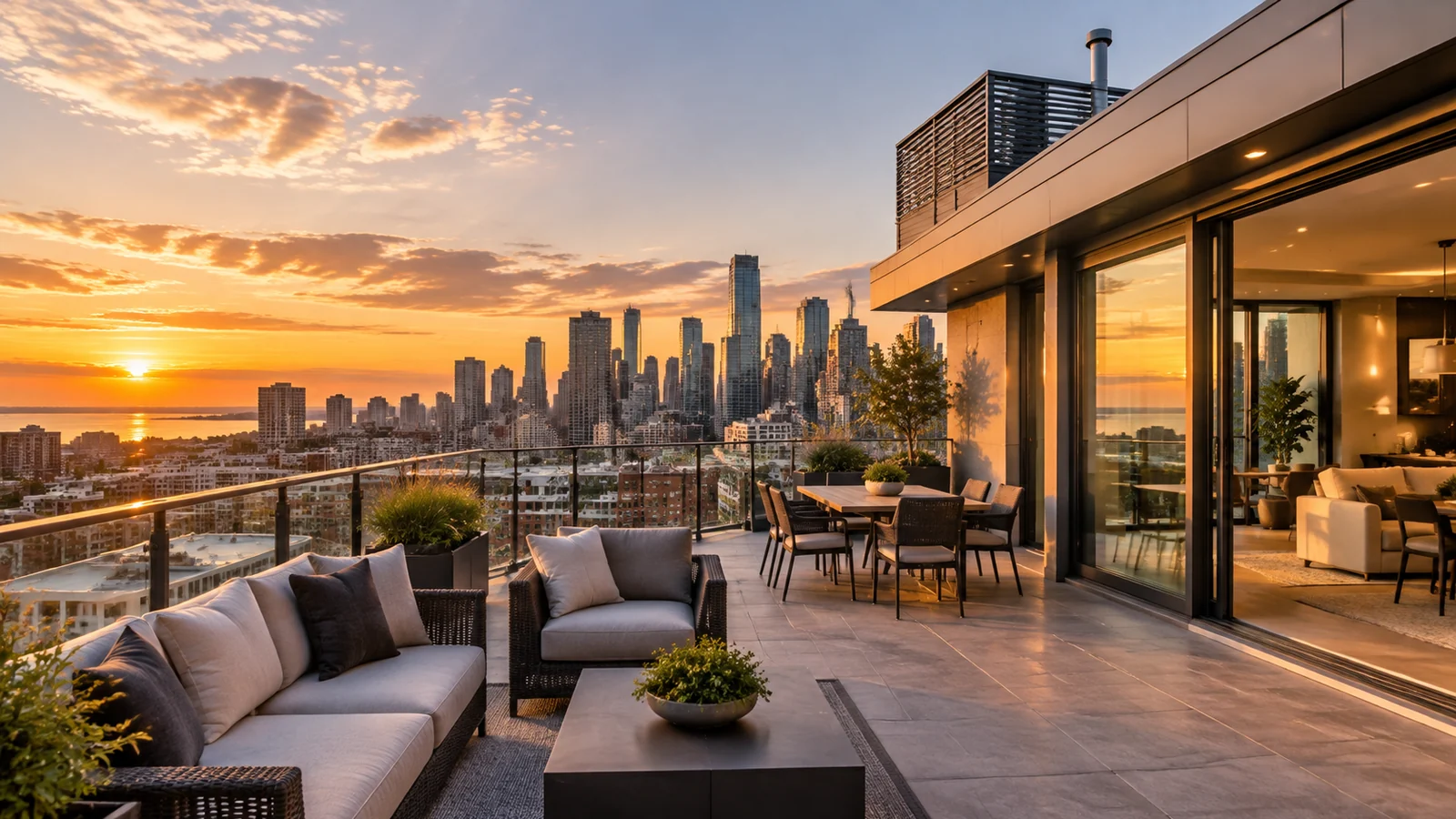
For an Ontario condominium, distinguish the registered unit from common elements and exclusive-use common elements. The Condominium Authority of Ontario warns that balconies, patios and terraces may be exclusive-use common elements rather than parts of an individually owned unit. Have your Ontario real-estate lawyer compare the declaration, registered description/plans, title and any applicable agreements with the sales floor plan. Confirm the precise boundary, any exclusive-use designation, permitted access and rights of the corporation to enter for maintenance. A seller’s use of a roof does not establish a transferable right, and an informal permission must not be valued as though it were registered title.
Ask what you may actually do on the terrace: permanent planters, decking, outdoor kitchen, barbecue, hot tub, pergola, glazing, drainage changes and gatherings are separate questions. The corporation’s declaration, by-laws and rules can restrict use; owner alterations to common elements commonly require board approval and a formal section 98 agreement. Ask for executed agreements, approvals, building permits where applicable, engineering documentation and warranties for existing alterations. The absence of an obvious complaint does not establish authorization. If a terrace improvement is essential to your purchase, obtain a clear written pathway to approval before treating the scheme as feasible; otherwise price the unit on its permitted current configuration.
Roofs, waterproofing and reserve-fund exposure
Roof adjacency has a cost and disruption dimension. Inspect ceilings, door thresholds, roof-wall junctions, drains and terrace finishes for staining, ponding, movement and failed sealants; a general viewing cannot verify hidden waterproofing. Request roof and membrane age, leak and insurance-claim history, engineer assessments, recent tenders, planned replacements and access arrangements for contractors. Establish whose duty it is to maintain an exclusive-use area, repair after damage, remove private improvements and restore them when the corporation opens the roof. Ontario’s Condominium Act and governing documents control the allocation; do not assume the roof belongs to the buyer merely because it is outside the suite.
Read the status certificate and financial package as a forward-looking risk file rather than a clean-bill-of-health label. The certificate includes governing documents, common-expense information, corporate financial records and reserve-fund disclosures; the corporation must provide it within 10 days of a paid request and may charge up to CAD 100 including taxes. Review the latest reserve-fund study, funding plan, audited statements, budget, notices, special assessments, litigation and the minutes or repair records reasonably available. A nominally large reserve balance does not prove sufficiency: compare planned roof, elevator, façade and mechanical work against the forecast and contribution increases. Have the lawyer and, when warranted, an engineer review troubling discrepancies.
Access, privacy, views and daily operation
A spectacular view can coexist with poor daily logistics. Visit at different times to measure lift waits, noise from roof fans, trash/service routing, wind at terrace level, sunlight, glare, building odours, heating and cooling performance and delivery or moving procedures. Confirm stair/egress arrangements and any accessibility requirements with relevant building documents and qualified inspectors, not the sales brochure. Ask about lift redundancy, planned modernization, terrace access during roof work, window-cleaning rigs, equipment clearance and emergency service routes. Identify whether guests and service contractors can reach the unit without crossing private space. These tests separate an attractive photograph from practical year-round use.
Do not describe a skyline view as “protected” without a documented enforceable basis. Examine adjacent parcels and current planning applications in Toronto’s public Application Information Centre, then ask a planning professional about zoning, approvals and the possibility of future buildings. A lack of a current application does not guarantee unchanged views. Compare privacy exposure from surrounding roofs and sightlines from new towers. Check that parking, storage and any private lift lobby have the ownership or use rights represented in the offer; they may be separate legal interests or common areas. Price uncertain outlooks as uncertainty rather than as guaranteed permanent amenities.
Compare the full premium and check buyer eligibility
Model the acquisition in Canadian dollars: purchase price, deposit, provincial Ontario land transfer tax, City of Toronto municipal land transfer tax, legal and registration costs, inspections, lender appraisal and mortgage costs, moving, insurance, annual property tax, monthly common expenses, utilities and a reserve for private improvements. Toronto adopted higher graduated municipal transfer-tax rates for certain high-value residential properties effective 1 April 2026; the correct property classification and brackets need transaction-specific calculation, not a single percentage copied from another listing. For an overseas buyer, also model the funding-currency conversion spread and transfer/bank charges using the actual lender or provider quote, rather than an invented exchange rate. The April 2026 Toronto rates are marginal: for qualifying property containing one or two single-family residences, 4.40% applies only to the portion of value from CAD 3 million to CAD 4 million and 5.45% only to the portion from CAD 4 million to CAD 5 million, not to the entire price. For a new-build penthouse, check whether GST/HST is included in the advertised price, whether any rebate actually applies and what remains payable at closing; an ordinary resale home is generally GST/HST exempt, subject to exceptions.
Eligibility is a separate gate from affordability. As of 25 October 2026 Canada’s federal prohibition on purchases of certain residential property by non-Canadians is extended to 1 January 2027, subject to statutory and regulatory exceptions; qualifying temporary workers and other categories may be exceptions but require evidence and detailed conditions. Separately, Ontario generally imposes a 25% non-resident speculation tax on applicable acquisitions, and Toronto introduced an additional 10% municipal non-resident speculation tax on qualifying transactions from 1 January 2025. Exemptions and rebates have different tests; exemption from the federal prohibition does not automatically remove either tax. Obtain a written eligibility and tax assessment from Ontario counsel before signing or moving funds. If a foreign entity is even one of several buyers, Ontario NRST may be levied on the full consideration rather than just that buyer’s ownership share; have counsel test the actual purchasers and structure.
Document requests and a go / renegotiate / stop decision
For a resale condominium, request a lawyer-reviewed status-certificate package and confirm whether the agreement makes the purchase conditional on satisfactory examination of documents, title, financing and inspections with workable dates and remedies. Ontario does not provide an automatic statutory 10-day cooling-off right for resale condo agreements. A new or pre-construction condominium purchase has a different statutory disclosure regime and ordinarily a 10-day cancellation period after receipt of the signed agreement, disclosure statement and Ontario Condo Buyers’ Guide, subject to exact statutory rules; projects also carry delay, interim-occupancy and cancellation risks. Do not transplant the new-build protection into a resale offer, or assume a new project’s marketed terrace will match the final registered plans.
Ask for a compact written evidence pack before making the premium irreversible: title and registered condominium declaration/description; terrace and unit plans; status certificate and governing rules; all section 98 alterations agreements; reserve study, financials and identified special assessments; roof, leak and engineering records; elevator and service schedules; parking/storage rights; property-tax figure; and specific financing and transfer-tax calculations. Have the property inspected within access limits, with a specialist review where roof or structure is in issue. Proceed when rights, condition and cost withstand review; renegotiate when a risk can be allocated or discounted in enforceable terms; stop when essential terrace rights are absent, access is unsuitable, major unknown liabilities remain or legal eligibility cannot be established. No listed property, valuation or future view is certified by this general guide.